
Free readable sample · October illustrated edition
Read it before you buy it
See how Ballistics 101 explains the physics, the evidence and a mistake you can actually trace.
Complete excerpts from the 69-page guide. The notebook and target observations are explicitly fictional teaching examples.
The flight has more than one reference
The line of sight is the straight reference through the sights. The bore points along a different line, and gravity curves the projectile’s path below its departure line.
A projectile does not rise against gravity. The apparent rise belongs to the sight reference: the barrel is angled relative to it. Gravity continues acting throughout the flight.
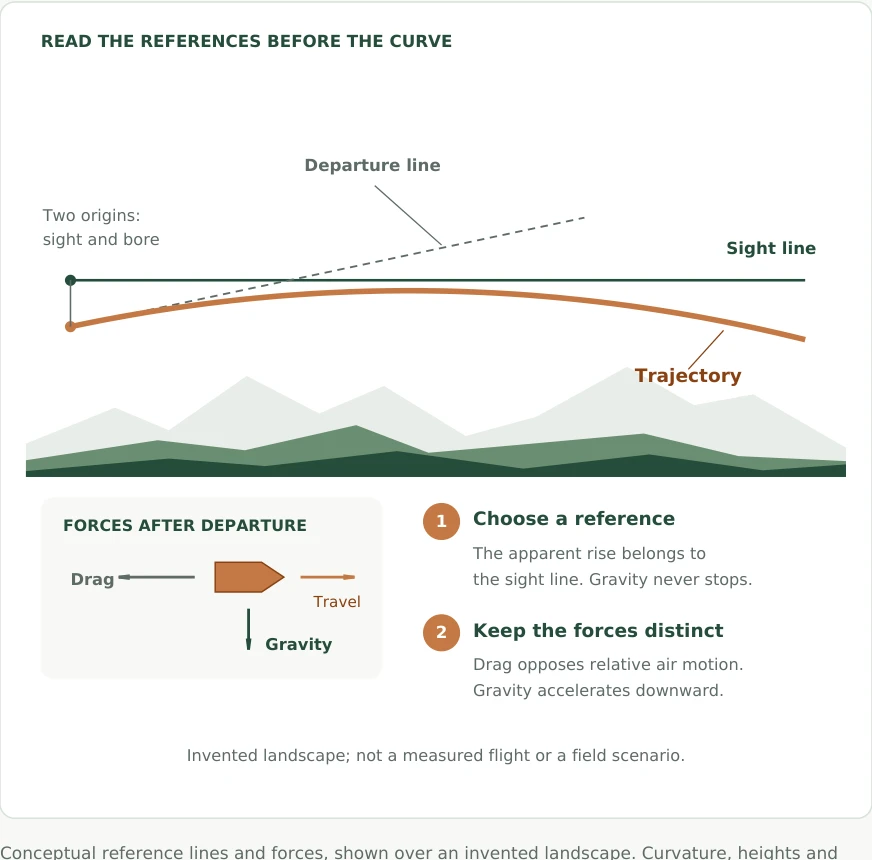
Choose the reference before describing “up” or “drop.” A zero is an intersection of the sight reference and the observed centre of impacts at a chosen distance. A calculated zero remains a prediction until it is confirmed.
A wind reading is not the whole path
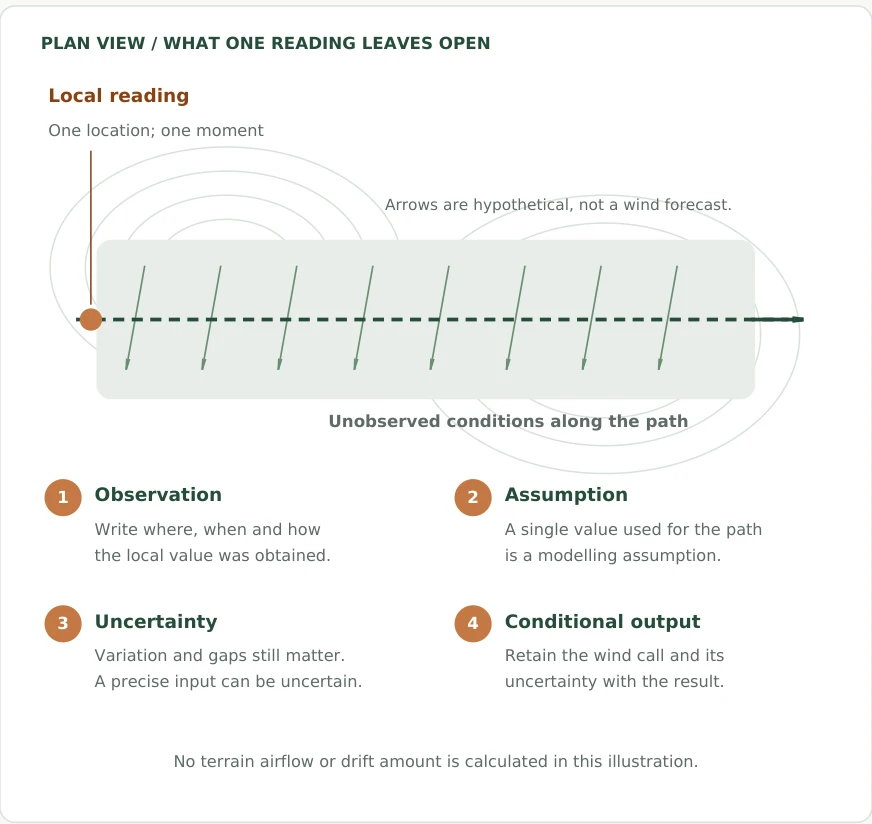
A correction asks, “What does the model predict for the wind I entered?” Uncertainty asks, “How different might the actual wind be?”
Those are separate questions. Two people can enter the same wind speed and obtain the same predicted drift while having very different reasons for trusting that input.
Completed example — two descriptions of the same entry
| Description A | Description B |
|---|---|
| “The wind is light.” | “My observation is local; I cannot observe the entire path.” |
| Source and time omitted | Source and observation time retained |
| No account of variation | Changes and uncertainty recorded |
| Output treated as settled | Output treated as conditional on the entry |
Description B supplies more context. It does not turn an observation at one location into a measurement everywhere.
A useful learning experiment
In the calculator, keep the setup and other inputs fixed and compare two wind-uncertainty assumptions. Write down which result changed and which assumptions remained fixed. Treat the comparison as an exploration of the model, not evidence about today's actual conditions.
If the numerical result changes, explain why in words before treating the new number as useful.
THE IMPORTANT BIT
A forecast, a local observation and uncertainty about the whole path have different roles. Record which one you have.
From a South Island notebook to a corrected input
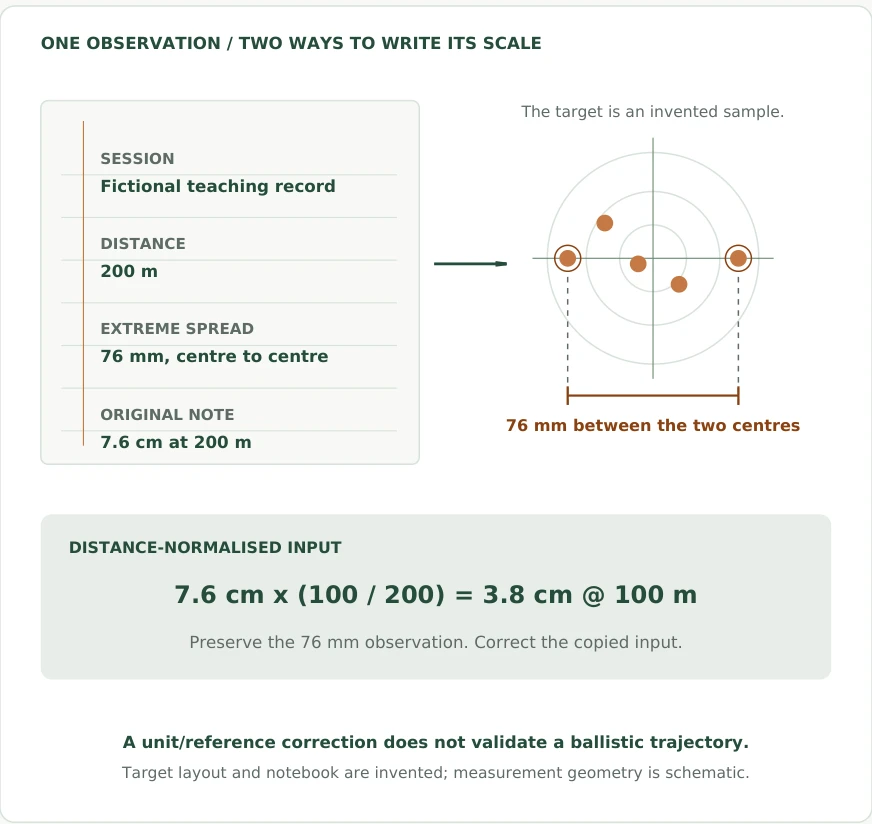
This is one continuous fictional learning case. The people, setup and observations are invented. The arithmetic is real. It illustrates a record error; it is not a firing solution or a hunting outcome.
1. Give the record an identity
Mere is preparing her notebook after three visits to a South Island range. She keeps the same rifle, factory-load lot, optic, prone position and support in this example. Her labels are Rifle A / Load A / Prone. She uses metres for distance and millimetres for group measurements. Her reason for practising is to understand her records before considering a field application.
The load catalogue is a published starting source. Her actual muzzle velocity is unmeasured. The notebook says so. Changing a group-size entry will not improve that velocity evidence.
2. Keep the whole notebook
At a recorded 100 m she retains five five-shot, centre-to-centre extreme spreads: 28, 41, 35, 47 and 39 mm. These are the same fictional samples used in the earlier notebook lesson. The arithmetic mean of the five spreads is 38 mm; the smallest is 28 mm.
She does not delete the 47 mm group. Nor does she treat the mean as a hit probability or substitute it for a particular recent group without checking the app's input meaning.
3. Make a conditional prediction
Her ballistic table is labelled model output. It retains the exact load identity, original velocity source, BC model, zero, atmosphere and date. This lets a later observation be compared with the calculation that actually existed, rather than a retrospectively edited table.
For the separate placement model, she uses a recent group from the intended position. She checks the group-size field's selected unit before entering a value. The current calculator defaults to cm @ 100 m. That means a distance-normalised group span, not the physical span at every distance.
4. Preserve an observation that appears to disagree
At a later recorded 200 m session, an invented group measures 76 mm centre to centre. Her quick note says “7.6 cm.” She copies 7.6 into a field still labelled cm @ 100 m. Now the model is being told about twice the angular spread represented by that observation.
The 76 mm group is an observation; 7.6 cm is a valid unit conversion. The error occurs at the next step: entering the physical span at 200 m as if it were already normalised to 100 m.
5. Resolve the record error with independent evidence
Mere returns to the original target note: distance 200 m, span 76 mm. Both values were written before she saw the model result. She also checks the field label. The normalised input is:
7.6 cm × (100 m / 200 m) = 3.8 cm @ 100 m.
Equivalently, 0.076 m / 200 m = 0.00038 rad, approximately 0.38 mrad. That is a geometric conversion of this sample, not a statistical estimate of all future shots.
She retains the original entry and corrects the input to 3.8. The group now has the proper angular scale. BC and velocity remain unchanged.
6. Write a conclusion with a boundary
| The case establishes | The case leaves open |
|---|---|
| A factor-of-two distance-normalisation error in one copied group input | Whether the ballistic trajectory is correct |
| The corrected angular scale of the 76 mm sample at 200 m | Actual muzzle velocity and its variability |
| A traceable reason for changing 7.6 to 3.8 | How representative these samples are over time |
| A record that preserves both the observation and correction | Any safe, ethical or humane hunting distance |
Her conclusion is specific: “I corrected a units/reference error. My original 200 m group remains 76 mm. The revised model uses 3.8 cm @ 100 m. This does not resolve the unmeasured velocity or establish a field outcome.”
THE IMPORTANT BIT
A satisfying explanation comes from evidence that distinguishes causes. If the original distance or measurement method were missing, this case would remain unresolved. Do not force a trajectory mismatch into this explanation merely because the arithmetic is convenient.
Continue with the full guide
Get all 21 core lessons, 27 vector figures, annotated app screens, quick reference, glossary and sources, plus a four-page fillable record pack.
NZ$12.99 including GST. One-off purchase. Calculator and practice tools remain free.
Explore the illustrated editionEducational material, not a loading manual, firearms training or permission to take a shot. The guide has not had independent specialist peer review.