
How this works, and where it's weak
What this calculates
Within Range currently estimates one component of a humane hunting outcome: the probability that a shot lands inside a circular vital-zone proxy under the inputs supplied. A vital-zone proxy is a simplified circle standing in for the chest cavity's heart-lung region, the target area used to convert your group size into a hit probability at each range. It is a modelling simplification, not an anatomical diagram; see "Vital-zone proxies" below for how directly each species' value is sourced.
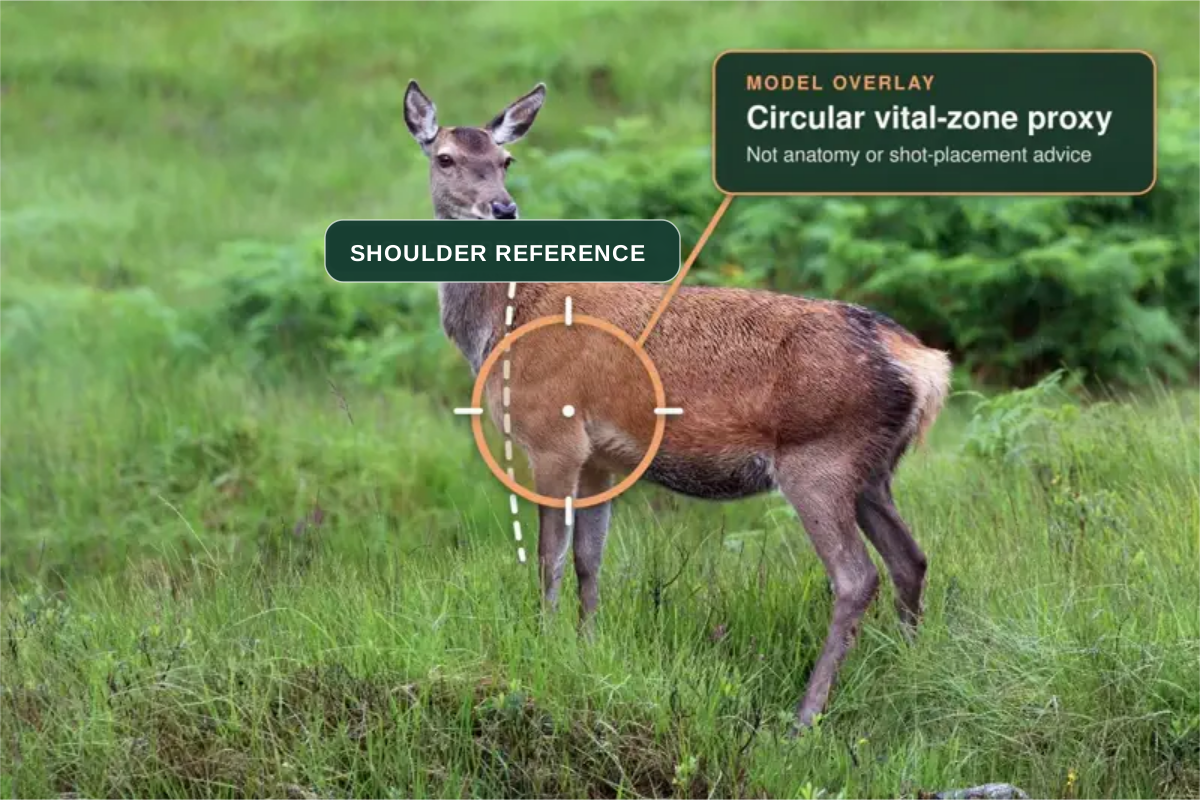
The result is the first 5 m range sample where estimated placement confidence falls below the percentage you selected. It is not a validated probability of rapid incapacitation, recovery, or an ethical shot.
Impact energy is plotted for context. It does not set the confidence boundary: the dataset's energy figures are legal or informal conventions, not validated species-specific predictors of humane outcome.
How it works
The trajectory calculation uses the manufacturer's published ballistic coefficient, muzzle velocity and test-barrel length, together with altitude, temperature and wind. Manufacturer velocity is not a substitute for chronograph data from your own rifle.
If you enter your own barrel length, published velocity is adjusted using Hodgdon Powder Company's published barrel-length testing: roughly 25 fps per inch of difference from the manufacturer's test barrel. This is a single average rate applied to every cartridge, not a measured value for your specific rifle, and Hodgdon's own testing found magnum and overbore cartridges can vary more than this average predicts. Leave the field blank to use the published velocity as-is.
Your group size is converted from observed extreme spread to a point estimate of radial dispersion, then combined with wind uncertainty. The group must have been shot from the position you select. Position is recorded as scenario context; the model does not add a position penalty because the previous coefficients were not measured field-dispersion data.
When you choose a comparable-session summary from Practice, the calculator instead uses a one-sided 95% upper confidence bound on dispersion. Only groups with the same rifle/load profile, practice distance, position and shot count are pooled. This bound is conditional on the centred circular-normal model; it is not a claim that 95% of shots will hit.
The resulting circular bivariate-normal model is compared with the species' circular vital-zone proxy at each range. It assumes the group is centred on the intended point of aim.
The Practice page's recent-versus-previous comparison is observed history only. It compares two three-group medians inside the same setup, distance, position and shot-count stratum. It does not prove that capability changed, apply a recency adjustment or change a calculator input.
Guided practice drills hold a user-selected setup, distance, position and shot count constant while groups are recorded. Every linked group counts toward the recording target, including groups that are not eligible for the centred calculator model. Reaching a drill target is a data-collection milestone, not a capability or humane-shot result.
If you provide a distance being considered, “What changes this result?” reruns the same placement model with one input changed at a time. It may show a closer distance, a lower wind-uncertainty value, a smaller future practice-group benchmark, or another position only when directly comparable evidence exists in this browser. These are conditional scenarios, not instructions or evidence that a shot is humane.
Where the numbers come from
Every recommendation-affecting dataset value declares the fields it supports, its evidence class, how the app uses it, the source URL, and the date it was accessed. The build fails when required source coverage is missing.
The model-use labels have specific meanings:
- Calculation: the value enters the mathematics.
- Eligibility: a conservative guardrail controls whether a result is produced.
- Context only: displayed information that cannot change the recommendation.
Manufacturer intended use is an eligibility guardrail, not evidence of humane terminal performance. A target or varmint projectile is not assessed for deer. A manufacturer-designated hunting projectile can enter the placement model, but that designation alone does not prove reliable terminal behaviour on a particular NZ species.
Where this model is weakest
It is a placement model. Projectile-specific terminal behaviour, shot presentation, physiological incapacitation and recovery probability are not yet quantified. The result must not be described as a complete humane-outcome probability.
Small samples. A manually entered group or direct single-session prefill remains a point estimate. The Practice page's comparable-session option widens dispersion using a model-conditional one-sided bound, but it still assumes a stable process and does not model changing skill, cold-bore offset, time pressure or recency.
Firing solution. Range-estimation error, zero error, sight height, elevation correction error and aiming bias are not modelled. The placement calculation therefore assumes a correctly centred firing solution and may be optimistic.
Long range. Published fixtures used to validate the trajectory implementation extend to about 450–460 m. Results beyond that are extrapolations of the point-mass model.
Vital-zone proxies. Red deer uses a cross-species whitetail proxy, and sika uses a value from a different sika subspecies. Fallow and chamois values are species-specific expert guidance, not clinical measurements. None changes shape for broadside, quartering or frontal presentation.
Impact-energy references. Red deer's 1,356 J value is the converted 1,000 ft-lb US rule of thumb. The 2,000 J values are from German hunting law, not NZ welfare research. They remain on the chart only to show how the trajectory compares with familiar references.
New Zealand validation. The model has not yet been calibrated against NZ field-practice or hunting-outcome data. Personalised, position-matched practice data and prospective local validation are still required.
Not legal or safety advice. This model's output is a number under stated assumptions, never a guarantee, a safety certification, or a substitute for your own judgement.